Playbook
How do landscapers turn finished jobs into content that wins work?
The short answer
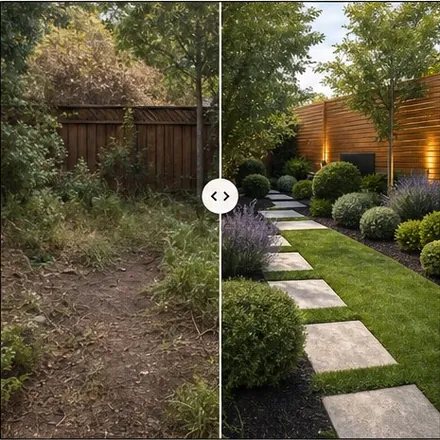
You win work by turning every finished job into content the same way: photograph it before and after from a fixed spot, then post the transformation as a short video, because that is what platforms show to people who do not follow you yet. One project is a week of posts, the reveal, the process, a detail, the crew. Do it steadily through winter and you book spring before it starts.
The advantage you already own
Landscaping is one of the few trades where the work photographs itself. A caption cannot compete with a weed-choked bed becoming a clean, planted border in the same frame. The proof is in the picture, and it costs nothing beyond the two minutes it takes to capture. Most companies still leave it on the ground. They finish, load the van and drive to the next job, and the best sales asset they will make that week is never taken.
A before and after does the job a testimonial only claims. It shows the standard, the scale and the finish at once. A homeowner scrolling does not need to be told you are good. They can see the hedge, the patio, the lawn, and picture their own garden in your hands. That is why this content beats stock photos and studio graphics for this trade.
What a strong before and after proves at a glance
- The standard of finish you hold to
- The scale of job you actually handle
- That the result is real, not a catalogue image
- What their own garden could look like
The two-minute capture habit on site
The content problem is never ideas, it is habit. Build one rule into the job and everything downstream gets easier: photograph the same view before you start and after you finish. Same spot, same height, same framing. The pair only lands if the angle matches, so the before shot has to be taken before anyone touches the site, even when it feels pointless.
Light varies, and that is fine. Overcast weather is your friend, because hard midday sun blows out detail. If the after shot happens at a different time of day, the transformation still reads. What matters is that the habit is automatic, not that any single frame is perfect.
The on-site routine, every job
- Take the before shot first, before the first tool comes out
- Note where your feet are, or use a fixed object, so the after lines up
- Shoot both landscape and portrait, you will want each later
- Hold the phone still for a five to ten second clip as well as a still
- Get one wide shot and one close detail: the clean edge, the joint, the planting
- Ask permission once, at quoting, to post the results
How one job becomes a month of posts
One decent project is not one post. Handled properly it is a week or more, and a good month of jobs fills a calendar without you sitting down to invent anything. The van is where the content is made. Posting is just scheduling what you already have.
From a single install
- The before and after together, the headline
- A short process clip: turf lifted, base laid, slabs down
- A detail shot: the crisp edge, the mortar line, the drainage
- The crew at work, faces and effort
- A caption that answers a real question, like why you dug that deep or how long it lasts
- A follow-up weeks later, showing it established or looking good after rain
The three formats that actually travel
Not everything spreads the same way. Three shapes reliably reach beyond the people who already follow you, and all three are things you can capture on a normal working day.
Keep them short and keep them honest. You do not need production. A steady phone, decent light and a real result beat a polished advert that shows nothing.
The three that reach new people
- The transformation: the before and after, ideally a quick video that cuts from the mess to the finish. The clearest proof and the most shareable thing you make
- The satisfying process: edging a bed, laying turf in strips, jet-washing a filthy patio back to clean stone. People watch these to the end
- The day in the life: you, the van, the graft, the weather. This sells you as the person a homeowner would let into their garden
Why this reaches people who never followed you
It is worth understanding how the machine works, because it changes what you make. On Instagram and TikTok, short video is the format the platform pushes to strangers, not just to your followers. Reels in particular travel well beyond your own audience. Benchmark data puts most Reel views on accounts the viewer does not follow. For a local business that is the point: you are trying to reach the homeowner three streets over who has never heard of you.
The platform decides whether to widen that reach by watching how the first viewers behave. Do they watch to the end. Do they send it to someone. A before and after of a garden two miles away is exactly the sort of thing one neighbour forwards to another. That is why the transformation and process clips work: they earn the watch time and the shares that tell the platform to keep showing them.
One caveat, so you do not chase the wrong thing. None of this is a lottery you win once. Reach moves around, a post that flew last month can land flat this month, and the only reliable input is posting steadily so the quiet ones do not matter.
Booking the season before it starts
The trap in landscaping is that marketing follows the workload. You are flat out in spring and summer, so you post. You go quiet in autumn and winter, so you stop, which is exactly when you should be filling next year's diary. Demand is seasonal. Your visibility does not have to be.
The content you banked all summer is the answer. Keep posting transformations through the quiet months and you stay in front of people while competitors go dark. When someone starts thinking about their garden in February, you want to be the company they have watched work all winter, not a name they have never seen.
Planning the off-season
- Shoot extra in peak season on purpose, to spend through winter
- Post design and planning content when nobody can dig: plant choices, what a project timeline looks like
- Run a simple early-spring booking offer and put a real date on it
- Reply to every comment and message in the quiet months, when you finally have time
Maintenance is the quiet engine
The transformations get the attention, but recurring maintenance is where a lot of the money is, and content supports it differently. Mowing, hedge-cutting, seasonal tidies and garden care contracts are the steady base that carries you through winter. They do not photograph as dramatically as a new patio, but they build something the one-off jobs do not: a visible, reliable presence, week after week.
A homeowner choosing a maintenance company is not buying a dramatic result. They are buying reliability and someone who turns up. Content that shows you doing the ordinary work well, over and over, is the argument for exactly that.
How content works for maintenance
- Show the same garden across a season, so people see you keep it, not just build it
- Treat the small weekly tidy as proof of consistency, which is what the client is really buying
- Post useful notes for existing clients: frost warnings, when to cut back, what you are doing this month
- Remember a maintenance round is a free photo opportunity every single week
Common questions
- How often should I post?
- Steady beats heavy. Two or three times a week you can sustain all year is worth more than a daily burst that dies in August. If you capture properly on site, a normal month of jobs gives you more than enough to post at that pace without inventing anything.
- Do I need to be on every platform?
- No. Pick one you will actually keep up, usually Instagram or Facebook for this trade, and post short video there. You can repost the same clips to TikTok in seconds, but do not spread yourself so thin that everything goes quiet. Consistency on one channel beats silence on four.
- What if the customer does not want their garden shown?
- Ask at quoting, not after. Most people are happy to say yes when you ask early and offer to keep the location vague. If they decline, shoot detail and process clips that do not identify the property. You lose the address, not the content.
- Is it worth paying to boost these posts?
- Sometimes, but earn organic reach first. A before and after that already gets watched and shared is worth putting a small local budget behind. Boosting a weak post just buys views that go nowhere. Let the content prove itself, then spend to widen the reach of the ones that work.
- Do I need good gear or editing?
- No. A recent phone, natural light and a matched angle are enough. Overcast days are kinder than bright sun. The transformation carries the post, not the production. Fussing over editing is usually a way of avoiding the simpler discipline, which is capturing every job the same way.
- Before and after feels like showing off. Is that a problem?
- It is not showing off, it is showing the work. A homeowner deciding who to trust with their garden wants to see finished jobs at your standard. Let the pictures speak plainly, keep captions honest about what was involved, and it reads as proof rather than boasting.